Posts

Showing posts with the label project-works

3628. On Promoting Oral Communication in the Language Class

  Teaching a second or a foreign language may be fantastic. And somehow hard.  That teacher has to be alert: he should teach language facts… but mainly he ought to foster communication in English or whatsoever the target language is.  Thus he may ask his students questions as prompts for further communication in the classroom.  Asking questions also by other students may be great – I have seen it in class this week. A female student asked another female student how this latter one managed at home if she only cooked simple meals. They have an intermediate level and we utilize a coursebook which is A2/B1 level – some lower intermediate grade. The question was absolutely spontaneous.  That questioning each other also can further the communication in the classroom.  Another point, look. It is not the same our students would convey just sentences or otherwise they would convey oral presentations of a few minutes or even longer, of course.  They can choose a...

3608. A Practical Way to Help Out Your Students Plus a Writing Activity

  The pandemic has brought us something good, well, more than one good thing. It is that since I had to teach online last school year, I also started to send emails to my students. This current school year we have returned to face-to-face lessons… and I keep sending emails to my grownup students, and it works!  For they feel their lessons and all the English course more of their own, and I can tell you that my students work and learn better. Well their lessons are just that, THEIR lessons. And they participate a great deal on those classes.  On those frequent emails I also push them upward at their feelings that they are actually learning English. I’ve written things like, You are being great at the lessons . You know, this is positive motivation. As well I let them know that I like to work with them.  Alike I attain to reinforce things I tell them on the classes themselves, by sending them those emails.  Something else for today. I think that we language teache...

3607. How to Cook an Oral Presentation in the Classroom or Wherever Else!

  On my last post I said that in a foreign or second language classroom our dear students should participate by speaking for quite long periods. It’s not the same to say one sentence than speaking for 5 or 10 minutes. And if we want for them to learn and acquire that language, well then they should give long oral presentations. And lose their natural fear to speak for those allotted minutes.  Expert teacher trainer Mary Jane Amaya taught me how our students can prepare that very oral presentation.  Basically and trying to remember I can describe the preparation process as follows.  First the student has got to choose his or her topic. They can do it by brainstorming possible topics and then choose their favorite one. Of course you can teach all that nice process by carrying it out in the classroom with the class of students as a whole.  So after that brainstorm they can vote or anyway select one topic.  Then they can again brainstorm possible points about t...

3446. How to Help Good Students in the Classroom

Image
Remember that I teach English as a foreign language.  In our classrooms we may find some few high-achiever students, some low-achievers and the rest could be medium-achievers or average students. On this post I’m writing about high-achievers.  These students have some common characteristics, by means of which we may know that they are that kind of learners. They’re marvelous people but also medium- and low-achievers deserve all our attention and respect.  High-achievers are in some way conscious they’re good students and they see themselves as such. They’re creative learners and can reflect about their learning ways.  They usually are positive, optimistic and joyful students, this latter case being: the older the more they can be joyful I’d say, from my experience.  These students, if treated in a correct way, can help his classmates. As well we must be careful with them: they might get bored in the classroom, so we could think of delive...

3128. Students' Creativity May Be Just Great!

Image
  We teachers have to take advantage of our students’ best chances for learning creativity, this is, to learn in a creative way. We could facilitate our students enough time for creativity, and so foster and boost their creativity whenever it’s simpler to provoke. Sometimes our students are about to show their creativity, and we teachers should take advantage of those times for our students to learn in that creative way. For instance we can set and assign project-works by teams, I would advise of three people, as I’ve said on other posts. Specifically our students might have got to search information and stuff about specific points within the school subjects: math, science, literature, history, chemistry, physics, sports, catechism classes, mother language classes… Well namely it’s like flipped classrooms: the students have to research about a specific point, topic or issue, and after that studying process, they will present their results and those topics themselves t...

2600. A Team of Students like a Fist

Image
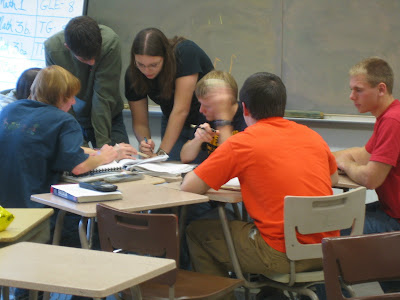
A work team should consist of three members, in my opinion. More could mean that one of the members would work much less than his classmates.  One of the members will become the leader – this is natural and logical, and experience says so.  They should deliver what each one is going to carry out.  When presenting their work to the rest of the class one should be the main speaker, every one of them should say something though. / Photo from: www jsc ac uk

2293. Taking advantage from pain in our world

Image
And a prayer for the Baltimore thing and riots.  We teachers of English can tell our students about all this issue, and education of our youth. Even we can tease (in the good way) to look up information about those happenings in English in the Internet.  You teacher can see some other teachers' posts about this topic in TeacherLingo. / Photo from: www sonesta com

2034. Educating students in sensitivity

Image
Something that seems sound is to take our students to an art exhibition or an archeological museum or to an excursion to the countryside.  The point is making them more contemplative and also because fine arts for example, educate them, making them more delicate and capable of appreciating both beauties of nature or artificial ones.  Besides, since we’re teachers of English or another language, we can implement some work or a work project, from the simple: “Write about your experience at the countryside today” to work projects.  Therefore the point is to educate their sensitivity, and sometimes be less rude. / Photo from: Ideal-landscape miriadna com

2008. Learning how to get the most from the Internet

Image
With the chances the Internet provides us we can stumble against the rock of getting to learn more and more and in a compulsive way.  Students at the school can be assigned a project-work about our solar system, and if they’re young they can be overloaded by such a quantity of information, and they can get choked and unable to put some order and tidy up their minds.  So the teacher should tell them about how many web sites they can look up or make them focus on such and such subtopic or let them know how many hours they can devote to the project-work.  That, I guess, is a nice way so as to educate the students for the use of the Web. / Photo from: www asiasociety org. kids focused on a project work

1550. Connecting people

Image
Teaching English cannot be confined and limited to something technical.  We as teachers ought to teach people – our students and all the center or school – to communicate with one another.  An example could be to set as a project-work to prepare a topic to present in the classroom, for 3 minutes and longer. After the presentation the other classmates should be allowed to ask questions and show their point of view.  Our labor has to get people together in some way, also with people out of the school and out of the country. / Photo from: Translation digitween12-2 flatclasroomproject com

1473. Group working, how to learn to work

Image
Teacher A said to teacher B, “Working in small groups is plumb essential: they learn to cooperate toward a common goal.  You can practice this way of working if you teach them or, better said, you give them some prompts and clues and suggestions. In this way they learn how to work in a group: turn taking, brainstorming, delivering tasks among the members of the group.  The groups could be of 3 people: in some way you assure that tentatively all of them will do some tasks, they will carry out the project by the 3 of them cooperating.  Naturally one of them 3 will be the leader.” / Photo from:  students learning www oru edu

841. Have your students think

Image
One day teacher of English A said to teacher of English B, “I think carrying out a project-work at school is a pretty good activity within part of the essence of school: learning to learn and think. Drills and speaking in English are good practice in the class. However, don’t forget the major aptitudes of your students, for example thorough thinking. This thinking will push up their process of acquiring English toward a high level. One possible activity: assign your student to make up groups of three, or set the groups yourself, to carry out a project-work. A topic might be the recent history of your country and its influence on today’s society. The goal could be that one or all of the members of the team should present that issue by means of utilizing the smart board. The duration may be 45 minutes. Their age? 15 years onward. You can tell them some clues before the actual making up the project-work, as examples of possible steps they could implement during the ...

823. Observing things from another angle

Image
One day teacher of English A said to teacher of English B, “Often, I believe, the best manual and handbook for me, teacher, to continue learning my dearest job is my students themselves. Imagine now a teacher that is at hand of his students’ all the time, that he’s attentive to the way they’re carrying out a project work or an exercise in the class, by small groups, for instance: he is continuously learning about the way his students think, their strong points, their weak ones, the way the students face up with problems, who the leader is. In this way the teacher is recycling his way of teaching, and alike viewing the topics also from their students’ points of view. I can assure you that a big part of what I know as a teacher has come from my students, not only from books and the Web - which are indispensable though.” / Photo from: brisbanecbdhotels blogspot com. Brisbane shines even in the wet. Brisbane, Queensland, Australia      

644. Using English for communication. More games

Image
One day teacher of English B said to teacher of English A, “On post #259 I gave you a lot of activities and games that may help our students play with English, and construct sentences or texts in English. With passing months and years I’ve invented more games/activities and as well learned from the reactions and ways of doing things by the students themselves. On label ‘more games’ in this blog you can find some more. Now I offer some new games, briefly: 1. The teacher invents and tells a simple story, by speaking, with 3 or 4 words the students provide; young students are very imaginative. 2. One student says a sentence with one word he or she has learned lately in the classes. 3. Elicit and give terms related with computers and the Internet. 4. They say, by turns, words that include one letter, but which words don’t begin with that letter. You can write them on the board; students like to see filling with columns of words by themselves; it’s like a competition. 5. They, with your ass...

635. Enhancing the students' work

Image
One day teacher of English A said to teacher of English B, “Group working can bolster our students’ creativity. The groups should be of three members – for example – so as more easily rope each member into the work. Men and women are social by nature, and people often work in groups. If all the students contribute to the process and final result of the work, this result may be a nice consequence of each student’s creativity. Also you can find more things about group working at the labels ‘problem-solving activities’ and ‘project-works’. Working in teams can help the students become more aware of the importance of their work.” / Photo from: jpacte learningcentered org

537. Practicing for the near future

Image
Here is a set of activities I help to compose, for a three-week course of English; a set of activities directed to the advanced students. We tried to think of high level activities, professional ones inasmuch as possible; as well as useful for the students’ near future. This document was included in the book I wrote for teachers of modern languages. Sorry for I don’t find italics in the laptop I’m using these days. I have corrected some mistakes, left some others. / Photo from: tennis-game-400 sports-information org Apéndice 18 Objetivos para un curso de inglés de verano. New version of ’07 CE Mainlines after a conversation with the Assistant of the program This layout might be taken as well for the Top-level group #304 May 18, 2007 A. Advanced group. Professional status-like. Demand the following three objectives from the NN Academia’s teacher. Core point: help the students learn and practice professional English, in view of social current realistic demands, plus what their parents to...

523. A great vehicle

Image
One day teacher of English A said to teacher of English B, “The English language is a vehicle. A vehicle to connect pople. Teaching and learning English is not the ultimate goal. We can use this language as a vehicle to study other school subjects. Or topics which are actually interesting to our students. Human topics. Engineering, history, history of philosophy, football, current news, art, new technologies... However if we teach a subject in English, there may rise a possible problem: our students could learn, for example, biology, and biological terms, in English. I have not a definite solution, do you? Anyway more and more in Spain the students in institutes and schools are becoming bilingualists. So, fill your classes with contents. This is Content-Based Instruction.” / Photo from: netherlands-landscape-601-2 deshow net

495. Did your students design this!

Image
One day teacher of English B said to teacher of English A, “Your students can learn a lot by carrying out project-works and making up posters, about one topic they’ve chosen. They work in pairs. In the class you can make a brainstorm of ideas from them, for possible projects, related to their likes and interests. So they´ll suggest topics, with your help. Next, they make some simple research, on the Internet, in English: sport, current news, science, a film, skiing and resorts in Sierra Nevada (Granada), our natural environment, hurling international league, history of Britain, customs and dresses, cuisine, 3D cinema, dinosaurs, the house of the future. They can write a summary of an interesting text found on the Internet. And the last step is pasting their summaries – very brief ones! – and some pictures on a card poster, to be hung on the walls of the classroom; for example, you might select four posters.” / Photo from: dezeen com. A project by Norman Foster.