Posts

Showing posts with the label presentations

3678. What to Do to Have Nice Discussions in Class

  I’m an English language teacher. And I consider that my dear students would speak in that language is the main goal, don’t you think so?  They often say sentences in class, if they are at a low level of mastering English. My higher-level ones intervene for longer and we hold nice discussions in class. Definitely I have to have them all of my students would contribute to the class for longer than mere sentences. I must have them speak for rather long.  Some years they have prepared oral presentations to speak for some minutes … or the whole lesson sometimes.  Definitely also it’s not the same to say just sentences than to have some conversations or some discussions.  Lately more than before this current school year I can observe that the textbooks we’re utilizing help out a lot.  By the way, I teach adults and when I ask them, well, I try and ask tactfully, because obviously they have their privacy.  Moreover if we wish we would have discussions in cl...

3675. What I Do to Plan Lessons I Wish They Be Efficient?

  Lesson planning, you asked? You, like I do, may think that that is essential to teach efficient lessons. You may also be a second or foreign language teacher.  Today I’m telling you something of what I do, just in case it helps you out.  When I sit to plan a lesson, first I think about my dear students and what they do need, and perhaps also what they may be expecting. And then I specify a couple of aims and write them down at the beginning of the lesson plan, at the top.  Even sometimes I let my students – and I teach adults but the same may be applied to teenagers I guess – know what those two goals are – also for them to become more aware and more involved in the class. The more I get them involved in their own learning English, the more they will learn, sure thing!  So I first think how things are going on my lessons and try to solve those possible problems.  And the body of the lesson plan includes stuff where I have my students speak a lot, a lot, a...

3665. What Is a Good Lesson like? Some Approximation

  Are you a second or foreign language teacher? Well, you may have realized the fact that that school subject is different from others.  We are dealing with a practical subject, a very practical one indeed.  We teachers do not confine to teach language facts, but we help our students would speak in that language, English for example. Even lessons are conducted in that language.  We do not confine to explain some concepts, like grammar patterns, and subsequently our dear students learn and study them and eventually they will have to pass an exam or test.  We teach them to use the language. And in class we carry out some practical activities, so our dear students partake a lot: both teacher and students are the lesson protagonists.  Well, by the way, we must expose our students to much English, by us ourselves as teachers plus from videos and audios.  Dick Allwright said that in class there must be “exposure, motivation, and opportunities for use”. Those...

3628. On Promoting Oral Communication in the Language Class

  Teaching a second or a foreign language may be fantastic. And somehow hard.  That teacher has to be alert: he should teach language facts… but mainly he ought to foster communication in English or whatsoever the target language is.  Thus he may ask his students questions as prompts for further communication in the classroom.  Asking questions also by other students may be great – I have seen it in class this week. A female student asked another female student how this latter one managed at home if she only cooked simple meals. They have an intermediate level and we utilize a coursebook which is A2/B1 level – some lower intermediate grade. The question was absolutely spontaneous.  That questioning each other also can further the communication in the classroom.  Another point, look. It is not the same our students would convey just sentences or otherwise they would convey oral presentations of a few minutes or even longer, of course.  They can choose a...

3613. Are Your Students Autonomous Learners? How to Work It Out: Some Hints

  Time flies. And thus we have less than three months left of classes. Today I wanted to give you five more points or tips about our lessons, in case it might help you to attain successful foreign or second language classes. I teach adults, yet all this may be carried out with high school kids too.  1. Next Wednesday one student will give an oral presentation – a simple one – on phonetics, phonetic transcription and the IPA, or international phonetic alphabet, because a learner of for example English should know how to interpret the phonetic transcription of a word he might look up in a dictionary.  2. We have no course-book properly, yet I use a B1 textbook to find and learn about examples of activities I could implement in class. B1 is lower-intermediate level.  3. I take texts from that book to implement listening activities, for my students need to practice that language skill. I carry out lead-in activities before the listening proper, and follow-up ones always....

3607. How to Cook an Oral Presentation in the Classroom or Wherever Else!

  On my last post I said that in a foreign or second language classroom our dear students should participate by speaking for quite long periods. It’s not the same to say one sentence than speaking for 5 or 10 minutes. And if we want for them to learn and acquire that language, well then they should give long oral presentations. And lose their natural fear to speak for those allotted minutes.  Expert teacher trainer Mary Jane Amaya taught me how our students can prepare that very oral presentation.  Basically and trying to remember I can describe the preparation process as follows.  First the student has got to choose his or her topic. They can do it by brainstorming possible topics and then choose their favorite one. Of course you can teach all that nice process by carrying it out in the classroom with the class of students as a whole.  So after that brainstorm they can vote or anyway select one topic.  Then they can again brainstorm possible points about t...

3606. Lesson Planning and Having Our Students Speak for Longer in the Classroom

  Lesson planning takes quite a lot of a teacher’s time. If you teach a language, you may have had the following experience.  A foreign or second language teacher, I think, should foster speaking in the class. A lot of speaking. In that language.  Thus that teacher should plan activities which will make his or her students speak. And not only will that teacher make his or her students participate by uttering and conveying sentences, yet he or she ought to take their students give longer messages, for it is not the same to say a sentence than talking for five or ten minutes. There is a big difference indeed, and our dear students should speak for pretty long periods.  With creativity, imagination, practice and even a bit of fantasy the language teacher should plan his or her classes, so as to give their learners chances to speak.  Well also the other three skills: listening, reading and writing.  Yesterday during the lesson I was teaching I came to think tha...

3604. Trying to Have a Lesson Where Both the Teacher and His Students Can Work Better

  And now I’m trying to say something which could hopefully help you out on your lessons, above all if you are a teacher. I’m telling you something from my classes to adults, yet same things could be said for teaching kids.  Ten points, ten.  I would say that for teaching English or any other language and, if possible, you the teacher ought to say all in that target language, or more than 90%. Well if everything is said in L2, much better. Even your announcements to your students, about logistics. The communication problem may be convenient for them to learn and acquire the foreign or second language.  Second, while talking to your students, look in their faces also for them to have eye-contact. That will help you reach them more fully with your messages and also that will help you keep the class tight – for classroom management and sere discipline.  Third, your messages to them have to be clear: speak in a finely or roughly tuned level, so that they can follow ...

3603. On Correcting Our Students in a More Clever Way

  I can see you are so concerned about being a good teacher. Let’s see if I can help you out.  And you wish to really assist your students.  What about trying to improve your correcting your students?  Now I’m reading about correction and giving feedback to our dear students from great British expert Jeremy Harmer – he’s an expert on teaching languages.  The first premise is that our dear students do need feedback about how they have performed in the class, okay? And we want those people would learn and improve their work, okay?  The second premise is that positive motivation is a tremendous learning booster.  Yet also we have to correct what they did wrongly. Well I particularly give both positive points and negative ones when correcting their written essays, and also sometimes when the students have given an oral presentation about some topic. And they appreciate both positive and negative feedback.  As well there is a big difference when correc...

3213. Getting Enthused Students Too

Image
  The teacher should manage the classroom and the students’ behavior, but ultimately these people should have prevalent freedom to behave as they think better. We’ll teach and show them what is better. If we achieve to love them they will respect us teachers, more likely than not. Otherwise with a “terror regime” they could obey us but they will not develop as persons. Thus sensible authority must be exerted with respect and love toward the students; otherwise they will obey but not as free persons. We teachers have to teach our students why behaving nice is good for them. We have got several reasons: respect toward the teacher, who is an adult person; respect toward one another, who have to work at their now-professional work, which is learning and studying; respect toward their parents and families, who ultimately are paying their taxes to have nice schools all over the nation; and last but not least, respect toward God – with transcendent views it is easier and simpl...

3128. Students' Creativity May Be Just Great!

Image
  We teachers have to take advantage of our students’ best chances for learning creativity, this is, to learn in a creative way. We could facilitate our students enough time for creativity, and so foster and boost their creativity whenever it’s simpler to provoke. Sometimes our students are about to show their creativity, and we teachers should take advantage of those times for our students to learn in that creative way. For instance we can set and assign project-works by teams, I would advise of three people, as I’ve said on other posts. Specifically our students might have got to search information and stuff about specific points within the school subjects: math, science, literature, history, chemistry, physics, sports, catechism classes, mother language classes… Well namely it’s like flipped classrooms: the students have to research about a specific point, topic or issue, and after that studying process, they will present their results and those topics themselves t...

3009. How to Get Feedback from Our Dear Students

Image
  So we’ve seen that in our English-language classes we should have immersion, and an atmosphere of immersion and communication in English, our target language, even right before the class, when you arrive at the classroom. So immersion, okay… but they, the students should understand us teachers… How!? Explain well: utilize the whiteboard or chalkboard or smartboard, give your students examples of what you’re teaching and saying, get feedback from them, ask them, get feedback from facial expressions, so as to check out if they’re understanding you, speak clearly, stop to clear up doubts and questions, use graphic material, project material on the wall from your computer, speak clearly, vocalize, use cognates or similar words both in L1 and the target language, use drawings or diagrams, one student can explain what we’re saying in his own words, ask them if they have any question, etc. Make sure they can follow you, maybe not all but a sensible ...

3006. Our Students as Experts about A Topic!

Image
  Oral presentations by students is an interesting activity, because they have to speak for longer than just when answering questions we teachers might ask them. They have to talk about a topic and not only reply a question by their teacher. We can advise them how to work out this activity, what steps they can follow. First they can produce a brainstorm of possible themes, and then choose one by eliminating the rest. After that they can write two columns: one with the things they can talk about in English, their target language, and one for the things they cannot talk about in that language. They can receive help and assistance by the teacher regarding these latter points, or from one another. Later they can write about all those points, with the help of the Internet for getting information about their topics, if necessary. When they’ve written and developed all those points by writing about them they have a span of time assigned to each student in order to talk about t...

2711. A Nice Activity for Advanced Students: Debates!

Image
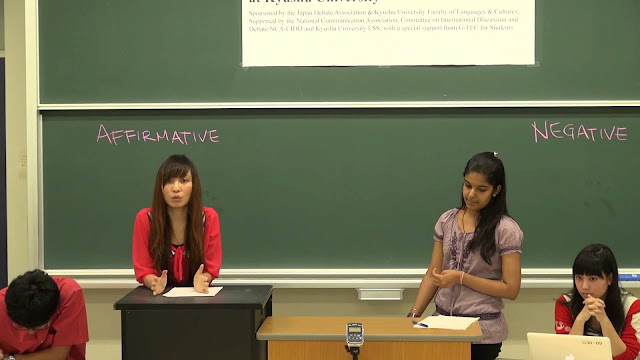
Debates are a good activity for rather English-advanced students.  It is important that the first team should try to find a point of union with the other team, and from there the first team can convey the two or three points of their message – to defeat the second team.  I hope to write a bit more about this interesting activity for teens and adults. / Photo from: www youtube com

2660. Are you scared to speak in public?

Image
When you or I have to give a presentation or speech or lecture we have to finish with clear and summarizing sentences, for pinpointing the essential.  This is paramount.  Famous   Spanish psychiatrist Vallejo-Nájera used to say a speech of any kind should be brief and natural; the audience should wish to listen to further.  So let’s remember that our lectures should be short and we have to conduct in a natural way.  Think for instance of a parents meeting. In my opinion if we are nervous we could start by referring to it with a smile; we even could attract the public. / Photo from: greatpresentations1

2575. Would You Like to Present It to the People, Yourself?

Image
Many people are scared to speak in public, aren’t they? Before a lot of people.  They would not speak in public, ever, but they have to, at some occasions.  I would tell you to be short, brief, people should want more, and secondly be natural, be yourself.  Plus a tip by Ballesteros De la Puerta. If you are asked by somebody amid the public, ask him or her their names. We like to be addressed by our name, right?  As well you could start by saying you’re scared and nervous, sometimes it is sound to say it – well, think of it. / Photo from: Overcoming-fear-of-public-speaking www levo com

2298. Positive motivation hits the bell

Image
I’m mainly gotten involved in my adult students should speak in English. We have few classes left.  This morning some of my students, after having read it for rather long, have summarized a story I composed for them in a worksheet.  The main point is to be understood by listeners – namely me plus the rest of the class-group. They have made nice summaries, with mistakes and errors but they could be understood by the rest of us.  I can see my students are advancing, and I congratulated one of them specially, and let them know everybody is advancing.  What I mean is that positive motivation boosts a great deal the learning and acquiring of English by the students. I have clearly declared to my students that they are advancing. I’ve told them about this point lately more often.  Besides, at the end of the class-period, every day, I thank them for their attention, which is another point of positive motivation, I think. / Photo from: 1903 Ol...

2282. The importance of communication today

Image
Today I’ve been to a conference on journalism and for reporters.  Just I would like to pinpoint the importance of communication.  These conferences take place every year in a colegio mayor or college residence. / Photo from: boring-lecture www michaelmccuny net. This photo is just for fun

2268. Don't interrupt his speech

Image
When some student is speaking in the target language (English) for rather long, you teacher can correct him a few errors and mistakes, but let him go on by speaking in English.  Do not stop it. Do not interrupt him. Although he commits mistakes and errors. / Photo from: TYWLS

1971. Laugh at yourself

Image
The secret when addressing an audience – think of a parent meeting – is being naturalistic and being you yourself.  You could tell me, ok but I have mistakes and get anxious. And I would tell you – not me, experts – to let your public know you’re nervous and have a small laugh when making a mistake, and smile and laugh at yourself.  Parents just want you to teach and take their kid into close account. They want you to be demanding with their children or child. That’s it. / Photo from: A-Night-at-the-Opera-marx-brothers