Posts

Showing posts with the label babies

3644. You Can Learn a Lot by Just Reading Books, Look

  So we have – continuing what said on the previous post – that we can learn a foreign or second language, but also we can acquire it. Subconsciously. Similar to what little children do.  And we language learners have to receive a comprehensible input, to acquire the language. Thus we will be exposed to that input, which should be a bit above my actual level, thus we can proceed and advance in that language learning.  All this entails practical points for the classroom.  Remember all that was already said by Stephen Krashen from the seventies and eighties of last century. A great fellow this expert I guess.  He also said that you can learn & acquire the target tongue by reading books, and this is good news – I do like reading books and articles.  He puts that fiction books, like novels, help you a great deal in those learning & acquiring: those books bring everyday lexis and sayings and kinds of expressions. And even it seems better if you select th...

3563. On the Way We Adults Learn a Language. So Great, Look!

Do you need to learn a language? I do. English. I’m working on it.  Now I can help you by giving more advice from the scholar we’re treating about on our last posts, H. D. Brown, who is an ace at learning and teaching languages.  So now we could think that children, young ones, infants actually, have a lot of facility to learn a language, right? But if we are adults… So what? Adults have a great potential to learn and grab a language.  Our author puts, “(S)hould you, like a kid, try to pick up language subconsciously? The answer is a qualified yes. As an adult now, you most likely analyze yourself too much. Your tendency is to memorize, focus on grammar rules, translate from one language to the other, and do just about everything except subconsciously acquire it. You’re probably learning facts about the language at the expense of learning to use it. And one sure way to fail at learning a foreign language is not to use it for genuine communication.” (page 21 from the book...

2983. Why Can We Learn A Different Language?

Image
  Why can we learn, and acquire too, a language? Because we human people have an innate sense and capability of language, according to some scholars and to also scholar Susana Pastor Cesteros, of Universidad de Alicante , in Spain. A grand scholar who agrees with the theory of acquisition of also another language was Krashen. We human people have a capability of constructing our language and other languages in a creative way. All these theories are very practical: both if an infant –a child that cannot speak yet- and an adult, if exposed to a language, they can actually learn and acquire it. So because of that we teachers should dedicate a massive output of production of a second or foreign language, like for example English or Spanish, in the classroom. We should provoke immersion into those tongues in our classrooms and at our class-periods. Immersion, immersion is a key point in teaching English, French, etc. Let’s not speak in the mother tongue but all in the ...

2956. When Your Children Learn and Acquire A Language

Image
  “They don’t know it, but they’re learning!” said David, a gentle veteran teacher at our summer camp, some weeks ago. I liked it. It had been the first class day, and they had been playing to guess who the celebrity was. It’s a guessing game, a fun one, which makes the students ask the teacher questions about a celeb they have to guess. What I liked the most was that those kids (teens) were actually learning, nearly or fully inadvertently! It’s the summit of learning and acquiring a foreign or second language! However I also like when students may recognize they’re really learning. Infants (“infant” means “the one that cannot speak, in-fant = no-speak”, so babies or even very young children) acquire the mother language from their moms, and dads too, but I reckon that chiefly from their moms. Otherwise try to observe how moms repeat the same message or just a phrase to their dearest babies, like they were playing with those infants. Try to listen to moms talking t...

2701. Families now

Image
Inside a family we’ve got to combine working out by the two parents mostly plus home care.  The point may be every member of the family should invest time at home, at chores and at baby care, for example.  Now fathers cook, take care of the family baby or babies, also changing the diapers (or nappies, in UK) for instance.  Every family member must provide something, if we want that house turns out good and pleasant to live in.  Besides we’ll be preventing our kids from playing video-games too much. What they’ve got to do is studying and doing homework and doing some housework as well. / Photo from: o-FATHER-SON-COOKING-facebook www smoothteddy com 

2683. Assume Toddlers Can Learn Huge

Image
Young children and toddlers have a mental potential that, if stimulated, can give a lot...  A young kid two years old is capable to read.  A doctor told us this at a lecture, a few days ago.  He finished his degree of Medicine when 19 years, and reached the doctoral dissertation at 22.  So the thing with toddlers and young children is making them move in the classroom, so as to connect their neurons, and thus they can input and intake a lot, like English for instance. There are two ways of naming things, in English and in Spanish, though they aren’t aware of this phenomenon; for them it’s something natural. / Photo from: toddler-teeth www orlandofamilymagazine com

2678. Children Often Are Awesome!

Image
Yesterday I attended a lecture by Dr. Kovacs. I will try to pass you on some of the marvelous and amazing things he said, like for example the fact that a child of two years can learn to read, and read actually, and so he becomes more autonomous for his growing up and discovering things a child that age can like, namely mom and dad, and others.  Before the actual speech, a counsellor of the city hall, as an introduction, said that we teachers do not just confine our labor to teaching and instructing, but also to giving values and fostering virtues.  By the way, a child aged two can be stimulated so early as to be able to recognize the letters and so to read a text. / Photo from: getty_rf_photo_of_toddler_scribbling www webmd com

2671. The population pyramid: some worry in Western society

Image
We teachers, even more in parents’ case, can fall in a fault for becoming superprotector parents.  Many families in Spain now have a single child, or two at the most. We have a problem of the pyramid of population: if this situation keeps being so, within twenty years there will be a lot more oldies than young people (!).  There is no population recharge.  Many families, this is also true, are sacrificing and giving up having a newer appliance or a car for having more children, or moreover they have to cut off vacations for a bit or concerning the destination.  In other words they are open up to receiving the kids God will give them, coming to the head of the problem.  Children in large families could learn better, from their brothers and sisters alike; this is taken from experience, from life as such – I know many families this kind. / Photo from: 143StudyAbroad www hercampus com

2662. Young children understanding English

Image
In our schools young children acquire English, because they’re exposed to speaking in that language.  So for them there are two ways of naming a color: “red” and “rojo”.  In their classrooms and other places of the school the vehicle language is English, and for them it is naturally so.  Their teachers have to be bilingual too. / Photo from: everydaylife globalpost com

2430. How Babies Acquire a Foreign Language

Image
Babies start to speak about one year and half, but since week number eighteen, the baby in mom’s belly can produce sounds.  After birth babies listen the same to their parents and adults in general a zillion times, and these adults repeat the same word or phrase, and the infant starts to repeat and pronounce those words, or short phrases, not full sentences.  You, father or mother, can take advantage of this phenomenon to make your children speak in English.  In general terms, infants and young kids have their brain forming itself, and at that point of time is when those children can acquire a language – adults also can acquire a language though; you can see the label or tag about acquisition and adult learners. / Photo from: mom-and-baby francesiacussi com

2404. Babies Acquiring Their Language: Awesome!

Image
The way babies acquire their mother language is taken by the communicative methodology of learning and acquiring the target language, English in our case, up to some extent.  They receive a day-long input from their relatives, moms for example, who treat their babies with a great affection. All this helps to acquire a language.  Alike, those relatives, moms and dads in the first place, make their babies repeat phrases or sentences, more phrases and words than long sentences.  Little by little those babies acquire the language, but before speaking they receive the massive input. This latter is rather long, and then, after 2 years, depending on each baby, he or she starts to speak.  Krashen said babies have a potential of grammar capability that is innate. / Photo from: MOTHER-AND-BABY oxygenhotel hu 

2331. Bilingual babies

Image
If you’re parents with babies, you’re fortunate.  Let’s think you’re Spanish: you teacher of English can talk to them some part of the day in English and some other in Spanish.  So for them there will be two ways of saying the same idea: “rojo” and “red”, and they will acquire English in their inside. / Photo from: www broonzy ah net

2202. When our babies start to communicate. Some implications

Image
Krashen wrote about the “silent period”, when learners of a second or foreign language listen a lot, much before they start to speak in English or any other language.  Lately I’ve been with babies of my family. They imitate adults: they listen a lot and subsequently try to repeat their expressions.  Mom and Dad and other relatives tend to repeat expressions to those babies, and the seed of language is being planted so. / Photo from: Baby’s-Good-Health www pinterest com

2164. What to do with babies acquiring a different language

Image
Babies can acquire two languages with not much problem. For them there are two ways for calling the same; for example “This is red” or “Esto es rojo”.  It’s an effort for parents anyway, and for teachers.  I would advise to have two specific and different periods of time, one in their native language, and one for the target language.  Some other times the problem is at school. In Spain there’re a lot of bilingual schools, and students have some school subject(s) in the target language, say English for example.  The thing and the problem is that they can learn history in English and have no idea how to talk about history in Spanish, their mother tongue. Any idea? / Photo from: london-2012-the-official-video-game-of-the-olympic-games-screenshots www g4v com. The picture is just for illustration sake

2086. Teaching babies and young children

Image
Moms and dads oughtn’t to repeat their instructions to their babies or young children. I mean, not repeat the same thing many times, otherwise the young kids get used to doing just what they like at any time.  In my opinion those directions should be uttered in an easy and serene way, not shouting.  If the young kid cries, the parents can explain the reason why of their instructions.  Young kids have open eyes and a developing brain, capable to record close to everything. / Photo from: woman-walking-with-stroller www sheknows com

1933. Acquiring the language since he's a baby

Image
Babies are pretty open to learn a language in which people around speak.  They're like sponges.  They acquire the language, in our case English.  They acquire two ways of communicating with their adults around, the mother and the target languages.  So, start as soon as possible to talk English at home. Other times you can speak in your mother tongue.  Lose fear to tell him things in English. At the beginning he won't say anything, but it's the silent period. Help with signals, gestures, tone of voice, pointing at something, repetition in different days. You're building up his English. / Photo from: stateswim net au. learning to swim

1794. Why Do Toddlers Start to Speak?

Image
Toddlers usually start to speak when they’re two or three years old.  Laryngeal organism is ready to start to speak. But it already was ready much before.  The thing has to do with brain.  When this latter one develops, it makes possible for the child to begin to speak.  Parents do a favor to their kids, especially moms, by repeating the same mumbling and the same things. The child lives in an atmosphere which makes him possible to speak, because there’s immersion. The first parts of the brain that make speaking possible are under the temples, at both sides of brain. / Photo from: toddler. www 163ed com

1777. Babies Learning a Foreign Language

Image
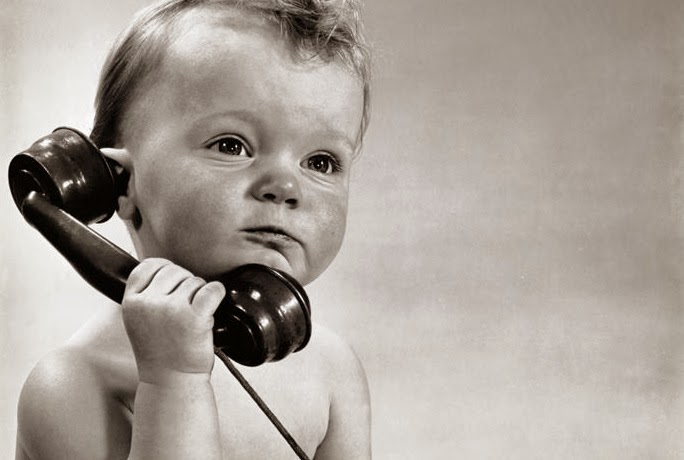
Babies acquire the language by hearing their own families around.  Moms may be not aware, but they repeat the same things quite often, so their babies are acquiring the language, English in our case.  It’s enchanting to see moms taking their infants in the baby buggies along the streets, speaking to their babies for long.  These latter ones cannot be conscious about this stuff, but their brains are incoming all those messages. They live inside an immersion of the mother language.  If you’re Spanish think of the way you can address your children in English. They way nonetheless is the same as in the mother language: repetition, repetition… and love. You’re good teachers. / Photo from: bebe-hablando-por-telefono amordebatmami com

1668. Acquiring English since they're babies

Image
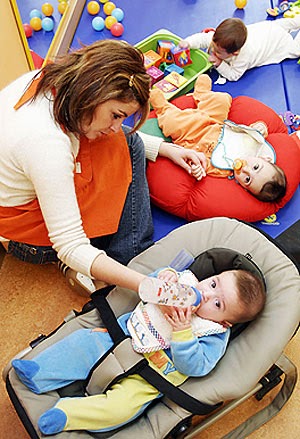
Things are changing in Spain, I said on post # 1664.  There are more and more bilingual schools.  Infants acquire English since they’re pretty young.  A teacher talks to them in Spanish, and another teacher does in English. And both are ways to communicate – to communicate with affection, which is the reason why we often communicate with other people, according to scholar Miguel-Ángel Martí. / Photo from: profesora con niños pequeños. magami blogs uv es

1378. What a nice family

Image
Teacher A said to teacher B, “That student is so bright because at home there’s an ambiance of fulfillment of duties for love to one another.  The parents are: he’s 44 and she’s 42. The relationships at home are steady, even peaceful, except for the younger children: 1 year, 2 and 8, who naturally are playful.  However, their elder siblings help their dad and mom with the toddlers' education . Someone strange could see there’s a high estimation of work and study, and sane games.” / Photo from: eorganic info